
Why Startups Need Co-Working Spaces (Lessons From a Kerala Coworking Hub)
Cost, speed, community, hiring - the four reasons why startups need co-working spaces, and when coworking is wrong.

On this page
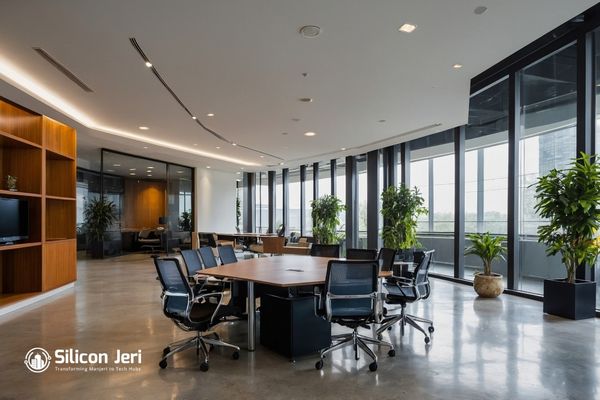
Cheapest way to buy speed and density
Real office. Real address. Real founder peers.
Key takeaways
- Cost, speed, flexibility, and community — in that order. That is what coworking actually solves for early-stage startups.
- Coworking removes friction on basics so the team can spend brain cycles on the product.
- In smaller cities, coworking does not just save money — it closes the metro gap.
- Coworking gives early-stage teams the legitimacy that closes hires and clients.
- Coworking is the right answer for most early-stage startups, but not all of them.
- Use these 7 questions before you pay for any plan.
- Silicon Jeri in Manjeri is a small but useful example of how coworking changes the math for a Tier-2 Kerala founder.
- Three objections come up every time. None of them survive a closer look.
Why startups need co-working spaces comes down to four things: cost, speed-to-set-up, flexibility, and community. A coworking space gives early-stage teams a real office, a real address, and real peer access without a long lease, so founders spend their time on product and customers, not on plumbing and furniture.
Ask ten founders why startups need co-working spaces and most will say “to save money.” That is part of the answer. It is not the most important part. The deeper reason is that a startup’s first 18 months are decided by how fast it can ship, how many smart people it bumps into, and how seriously the outside world takes it. A coworking space is the cheapest way to buy all three at once. This guide makes that case from first principles, using examples from Kerala, including Silicon Jeri in Manjeri, but the lessons travel to any small-city startup hub in the world.
The four problems coworking actually solves
Strip away the marketing and a coworking space is doing four jobs for an early-stage startup.
Cost. A traditional office lease in any Tier-2 or Tier-3 city eats six to twelve months of runway in deposits, fit-out, furniture, broadband setup, AC installation, and a power backup unit. Coworking compresses that to a single monthly fee.
Speed-to-set-up. A founder’s most expensive resource is time, not money. Coworking lets you walk in and start shipping the same week. Self-built offices take two to four months before you have a working chair, a working AC, and a working router on the same day.
Flexibility. Startups change shape every quarter. Three people becomes seven, then five, then nine. A flexible coworking plan absorbs that. A 36-month lease punishes it.
Community. This is the underrated one. A founder sitting alone optimises for the wrong things. A founder sitting next to other founders gets corrected fast, usually in a 10-minute hallway chat that would have cost ₹50,000 in advisor fees.
If you are skeptical that this is the real value, look at what well-funded startups do once they outgrow coworking. Most of them recreate it inside their new office on purpose.
How shared space accelerates execution
Execution speed in early-stage startups is mostly about removing friction. A founder who has to debug the office Wi-Fi at 9 am is not pitching investors at 9 am. A founder who has to drive across town for a client meeting is not coding the next feature.
A coworking space pre-solves the friction. Wi-Fi works. Power backup works. The receptionist signs for your courier. The meeting room is already booked. The founder gets to keep their attention on the things only they can do.
There is a second order effect that matters more. Inside a coworking space, useful things happen by accident. A designer overhears a founder describing a problem and offers a 5-minute fix. An ex-engineer shares the name of the recruiter who finally found them three good developers. A mentor sitting two desks away introduces the team to their first paying customer. None of this happens in a private office. All of it compounds.
Coworking as an unfair advantage in smaller cities
In Bangalore, Mumbai, or Delhi, founders trip over other founders on the way to lunch. The ecosystem density is the city. In a town like Manjeri, Malappuram, Perinthalmanna, or Nilambur, that density does not exist by default. You can run a startup for two years and never meet another founder by accident.
A good coworking hub manufactures that density on purpose. It is a single building where the local founder community gathers, for hot desks, for workshops, for monthly meetups, for client meetings. For a Manjeri founder, a Kottakkal-based product team, or an early-stage builder coming in from Edappal or Areacode, that single building can be the difference between a year of slow loneliness and a year of fast learning.
This is the deepest reason why startups need co-working spaces in cities like Malappuram. Not the desk. The dense, repeated exposure to people slightly ahead of you on the same path. That kind of access used to require a flight to Bangalore or a move to Kochi. Now it does not.
A small case for Kerala specifically
Kerala has an unusual mix of strong English skills, NIT Calicut (~50 km from Manjeri), University of Calicut (~30 km), MES College Mampad, Government College Malappuram, and a steady stream of returning Gulf engineers. The talent is here. The problem has always been the physical hub. Coworking spaces like Silicon Jeri are slowly fixing that, and the founders who plug in early get the compounding benefit.
The hiring and address problem
A 4-person startup pitching from a home address has a hiring problem and a client problem. Both are perception problems. Both are fixed cheaply by a coworking address.
A serious senior engineer in Kerala will quietly check where they will be working before joining a tiny startup. A clean coworking address, say, Silicon Jeri in Manjeri, near Manjeri Bus Stand area, reads as “real shop.” A house address reads as “side project.” The salary number does not change. The yes rate does.
The same applies to clients. Enterprise buyers, even small ones, do KYC on you. A real commercial address makes that step easy. A residential one slows it down. In an industry where the difference between “we’ll get back to you” and a signed contract is often a single objection, removing one objection is real money.
When coworking stops being right
We have to be honest about where this stops working. Not every startup belongs in a coworking space.
- Compliance-heavy work, fintech licensed by RBI, regulated insurance, certain healthcare workflows. The audit and physical security requirements often demand a dedicated, lockable space and a controlled visitor log. A shared floor will not pass.
- Hardware and lab work, startups soldering boards, milling parts, or running noisy machines need a workshop, not a coworking floor.
- Sensitive client data on physical paper, legal trust accounts, certain accounting workflows, classified government work. A shared printer is a real risk.
- Heavy security needs, startups working on defence, sensitive AI models with controlled hardware, or anything that requires biometric site access.
- Late-stage scale, once you cross 40 to 60 people, the cost math usually flips and a private office becomes cheaper.
The honest framing is this. Coworking is the right default for the first 30 to 40 people of most software, services, design, and content startups. Beyond that, or for the categories above, you graduate. That is not a failure of coworking. That is the point of it.
A founder’s checklist for choosing a coworking space
- Is the Wi-Fi tested at peak hours, not the morning visit? Insist on a video call from the actual seat.
- Is there a real call booth or quiet cabin you can book for client calls?
- What is the power backup setup? UPS only, or full-floor inverter / generator?
- Can you scale up or down by seat count without renegotiating a fresh contract?
- What is the community like, is there a founder presence you can actually meet, or is it mostly side-hustlers?
- Is the address acceptable for GST and current account documentation?
- Is the location practical for your team, your hires, and your clients (parking, public transport, airport access)?
If a space cannot answer 5 out of 7 cleanly, keep walking.
How Silicon Jeri illustrates the case
Silicon Jeri sits in Manjeri, in the heart of Malappuram. For a founder in Manjeri, Kottakkal, Perinthalmanna, Nilambur, Areacode, or Edappal, it offers what would otherwise require relocating to Kochi or Bangalore: a real office, a real address, real broadband, real call booths, and a real founder community within driving distance.
You do not have to take Silicon Jeri’s word for the broader argument. Look at how Kerala Startup Mission (KSUM), Startup India, and similar programs talk about coworking — they treat it as core infrastructure, not a perk. The reason is simple: every rupee a founder spends building their own office is a rupee they did not spend on the product or the customer.
Common founder objections – answered
Objection 1 – “We’ll be distracted by other people.” Real coworking spaces in Kerala have quiet zones, call booths, and headphones-on culture. The distraction in a noisy home is far worse, every single time.
Objection 2 – “It’s not really cheaper than a small rented room.” Add up broadband, AC, power backup, furniture, fit-out, deposit, and your time. The small rented room is rarely cheaper for the first 18 months.
Objection 3 – “Our team will lose its identity inside a shared space.” Identity comes from the team’s work, rituals, and shared problems – not from owning the walls. Some of the strongest startups built their first culture inside coworking floors.
Conclusion
Why startups need co-working spaces, in the end, is a question about compounding advantage, not real estate. Founders who use coworking right buy themselves cost discipline, ship speed, hiring credibility, and dense exposure to other builders – for a fraction of what a private office would cost in the same year. In a small Kerala town like Manjeri, or anywhere else with a growing startup hub, that combination is one of the cheapest unfair advantages an early-stage team can earn. Pick the space on purpose. Use it on purpose. Graduate when the math says so.
FAQ
Are coworking spaces really better than a small private office for a 5-person startup?
For most software, design, and services startups under 30 people, yes. The cost, flexibility, and community usually outweigh the privacy benefit of a small private office.
How long should a startup stay in a coworking space?
Most successful startups stay in coworking through their first 30 to 50 hires, then move to a hybrid setup or a private office once headcount and security needs make coworking less efficient.
Can a Kerala-based startup near Manjeri or Kottakkal really build a serious company from a coworking space?
Yes. With Calicut International Airport ~45 km away, NIT Calicut ~50 km away, and broadband options like Jio Fiber, BSNL, Asianet, and ACT, infrastructure is no longer the bottleneck — community and execution are. A coworking hub like Silicon Jeri solves the community side.
What should a founder check before signing up for a coworking plan?
Test the Wi-Fi from the actual seat, confirm the call booth setup, ask about power backup, check that the address works for GST and bank, and meet at least one current member to read the community.
Is coworking a fit for regulated or compliance-heavy startups?
Often not. Fintech under RBI, certain healthcare workflows, legal trust work, and defence-adjacent work usually need controlled access, locked storage, and audit-ready spaces that shared floors do not provide.
How does coworking help a startup hire better in a smaller city?
A real commercial address, professional meeting rooms, and visible peers make the startup feel like a “real shop” to candidates — which lifts offer accept rates compared to interviewing from a home office.