
Startup Office Space in Manjeri: Why Coworking Beats a Solo Lease
Why coworking beats a solo lease for early-stage Kerala startups in Manjeri - cost, flexibility, hiring, and growth.

On this page
Skip the deposit. Skip the build-out.
Walk in tomorrow. Scale month to month.
Key takeaways
- Flexibility, professional internet, meeting rooms, a real address, and a workplace that helps with hiring — in that order.
- A "cheap" rented office in Manjeri usually costs more than coworking once you add the build-out, deposit, internet, AC, and time.
- Lower upfront cost, faster launch, easier scaling, better hiring optics, and a built-in network — all in the same monthly fee.
- A serious workplace shifts how investors and candidates perceive you — at no extra cost.
- Match the plan to your headcount and stage. Do not buy a team cabin you have not earned yet.
- Plans built for one to fifteen-person teams, with the meeting rooms, internet, and address services that fundraising-stage founders need.
- Three avoidable errors burn early-stage Kerala startups every year. Skip them.
Startup office space in Manjeri is more affordable and lower-risk through a coworking operator than a solo commercial lease. Coworking gives founders a furnished office, fast Wi-Fi, meeting rooms, a registered address, and the ability to scale headcount monthly, without lock-in deposits, build-out costs, or a one-year lease commitment.
If you are evaluating startup office space in Manjeri for your founder team, you are probably comparing two paths: rent a small commercial space and build it out yourself, or take desks at a coworking operator. We will not pretend it is close. For most early-stage Kerala startups in or near Manjeri, coworking wins on every metric that matters in year one, total cost, time to launch, hiring optics, and the ability to change your mind. This guide breaks down what startups actually need from an office, the hidden costs of solo leases, and how to right-size your startup office space in Manjeri based on team size and stage.
What Early-Stage Startups Actually Need From an Office
A pre-revenue or early-revenue startup does not need a corner-office vibe. It needs a workplace that does five things well:
- Flexibility. You will hire, pause, pivot, and resize headcount. The office should resize with you.
- Professional internet and power. Sales calls and demos die without it.
- Meeting rooms. For investor calls, customer demos, and one-on-ones with hires.
- A registered business address. For GST, MCA, banking, and contracts. A home address is fine for one founder; it gets awkward fast as you grow.
- Optics for hiring. Candidates judge offices. A serious workplace closes hires.
A solo lease can deliver all five, eventually, after you spend three months and a chunk of your seed money on furniture, internet install, AC, and a security deposit. Coworking delivers all five from day one.
The Hidden Costs of a Solo Lease
Founders look at a rent number and think they have the answer. The rent is the smallest cost in the picture. A realistic Tier-2 Kerala solo office, even in Manjeri, has these line items:
- Security deposit – Often six to ten months of rent, locked up.
- Furniture and chairs – Real ergonomic chairs are not cheap, and folding chairs will cost you in back pain by month three.
- Air conditioning install – Buy and install. Maintain. Repair.
- Internet install and monthly bill – Plus a backup line if you are serious.
- UPS and inverter setup – Or a generator if you go bigger.
- Electricity bill – Higher with full-day AC and equipment.
- Cleaning, water, and basic supplies – Recurring forever.
- Reception and security – At small scale, you skip these and pay in interruptions and risk.
- Time cost of the founder – Every hour you spend chasing a plumber is an hour you are not building the company.
Now compare. A coworking plan rolls all of that into one monthly fee. You walk in on day one with everything working. There is no “we are launching in six weeks once the office is ready” excuse. You launch tomorrow.
The Bigger Hidden Cost: Lock-In
A solo lease in Kerala usually comes with an eleven-month or longer commitment, plus a sizeable deposit. If your team shrinks, your runway gets crushed by an empty office. If your team doubles, you cannot fit. Coworking plans renew monthly. You can shrink down to one desk during a slow patch or expand into a team cabin when you raise funding. That optionality is worth a meaningful premium on its own — and most coworking plans are not even at a premium. They are cheaper.
Why Coworking Beats a Solo Lease for Startups
Pull this out as a checklist. For a startup office space in Manjeri, coworking wins on:
- Lower upfront cost. No deposit at lease scale. No furniture purchase. No build-out.
- Faster launch. Walk in tomorrow. Solo lease is months.
- Headcount flexibility. Scale up or down by the desk, monthly.
- Professional internet and backup power, included. No setup hassle.
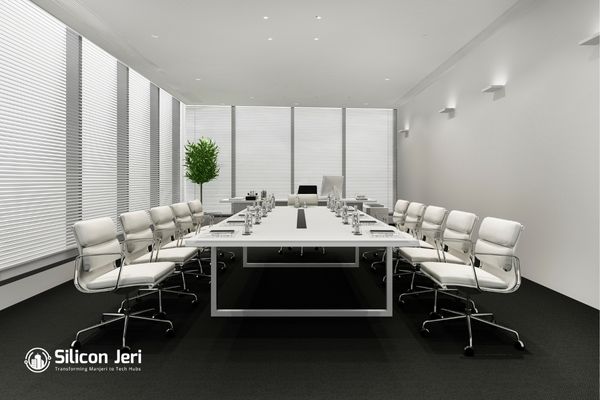
- Bookable meeting rooms. No need to build one or rent a hotel conference room.
- Registered business address. Available as a service in most modern coworking spaces.
- Hiring optics. Real workplace, real meeting rooms, real address — even at three people.
- Built-in network. You will meet other founders, freelancers, designers, and developers in the room.
There is one situation where a solo lease wins: when you have a specific operational need a coworking space cannot meet, a manufacturing setup, a clinic, a kitchen, a warehouse. For software, services, agencies, design studios, online businesses, and most Kerala startups in the digital economy, coworking is the right answer for the first two to three years.
How a Coworking Hub Supports Fundraising and Hiring
Fundraising Optics
A virtual coffee with an investor often lands at a meeting room visit. If they have to come to you, you do not want them sitting in a half-built room with one founder’s laptop on a folding table. A clean meeting room with a working video setup says “we are running a real company.” You do not need a fancy lobby. You need a space that does not undermine the pitch.
Hiring Optics
Candidates who join a startup are betting on the company. A real office with other working professionals around, even if half of them are not from your team — signals momentum. It quietly answers the question “is this a real job?” before the candidate even asks it. Founders who have hired through both a home office and a coworking setup will tell you the close rate is not the same.
Network Effects in the Room
You will meet a designer who can do your product UI. You will meet a developer who knows your stack. You will meet another founder who is six months ahead of you and has already solved the GST registration problem you are about to hit. A coworking space in Manjeri is not just an office. For a Kerala startup, it is also the cheapest network you will ever buy.
Right-Sizing Your Startup Office Space by Team Size and Stage
1–3 People (Idea / MVP / Pre-revenue)
At this stage, you do not need a private cabin. You need:
- Two or three hot-desk or dedicated-desk memberships
- Access to a meeting room for the occasional investor call or customer interview
- A registered business address if you are incorporating
- Headphones for everyone
Burn rate matters more than office vibe. Spend cheaply, ship fast, validate the product. Upgrade the workspace once you have revenue or funding to justify it.
4–8 People (Early Traction / Seed / First Hires)
Now the math changes. With four to eight people, distractions in a hot-desk setup become real. Look at:
- A small team cabin or a clustered set of dedicated desks
- A clear booking system for meeting rooms (you will need them daily)
- Whiteboard or screen access for product reviews
- After-hours access, you will run nights occasionally
This is the stage where founders are most tempted to take a solo lease. Resist. The flexibility of coworking is worth more right now than the slightly higher per-seat price you might pay vs a barebones rented room.
9–15 People (Scaling / Series A-ish / Real Operations)
At this size, you have a choice:
- A larger team cabin or a private team room within the coworking space
- Or a dedicated office floor with the operator handling the basics
- Or, finally, a solo lease, if and only if you have stable headcount, predictable revenue, and an ops person who can manage a real office
Even at this stage, many Kerala startups stay at coworking operators because the trade-off, slight per-seat premium for full flexibility, is still worth it. Solo leases make sense when you are confident you will be at this size or larger for the next two years.
How Silicon Jeri Supports Startups in Manjeri
Without inventing specifics, here is what a startup-aligned coworking operator in Manjeri should be offering – and what Silicon Jeri positions itself around:
- Plan tiers that match founder reality – hot desks for solos, dedicated desks for committed members, team rooms for small founder squads.
- Reliable business internet with backup, configured for the kind of video calls and uploads founders run all day.
- UPS-and-generator power backup sized for Kerala’s grid reality.
- Bookable meeting rooms with room for investor and client demos.
- Registered business address as a service for incorporation and GST.
- Local Manjeri presence, easy to commute to from Kondotty, Areacode, Perinthalmanna, Nilambur, and Kottakkal – and reasonable distance from Calicut International Airport for travel-heavy founders.
- Community of working pros, not just lounge-users – important when you are hiring or networking.
The right move is to walk through, ask for the specific plan that matches your team size and stage, and validate the basics yourself.
Common Mistakes Founders Make
- Taking a solo lease too early. Founders fall in love with the idea of “their own office” before they have customers. Lock-in plus build-out plus deposit equals dead runway.
- Buying a team cabin before they have a team. Pay for what you have, not for what you imagine.
- Choosing the cheapest space without testing the basics. Cheap internet, cheap power backup, and one-meeting-room-for-fifty-members will cost you customers. Spend on the basics; save on the lobby.
Conclusion
For most early-stage Kerala founders, the right startup office space in Manjeri is a coworking operator, not a solo lease. You get every essential, flexible plans, business internet, backup power, meeting rooms, a registered address, and a working community, without the deposit, build-out, and lock-in that crush early runway. Match your plan to your real team size, upgrade as you grow, and put your money into product, customers, and people instead of furniture.
FAQ
How much does startup office space in Manjeri usually cost?
Pricing depends on whether you take hot desks, dedicated desks, or a team cabin. In Tier-2 Kerala towns, all of these tiers are priced as a fraction of running a comparable solo office once you include deposit, internet, AC, furniture, and electricity. Ask for a current rate card and compute total monthly cost — not just the headline price.
Can I use a coworking space as my registered business address in Manjeri?
Yes — most modern coworking operators offer a virtual office or registered-address service that includes mail handling and a few meeting-room hours per month. This works for GST registration, MCA filings, and banking, and is far cleaner than using a residential address as your startup grows.
Is coworking really cheaper than a solo office for a small startup?
Once you add furniture, deposit, internet install, UPS, AC, electricity, cleaning, and the founder time spent setting it all up, coworking is almost always cheaper for teams of one to eight people. The bigger benefit is flexibility — you can scale up or down monthly without losing a deposit.
When should a startup move out of coworking into its own office?
When headcount stabilises above twelve to fifteen people for a sustained period, revenue is predictable, and you have someone on the team who can manage office operations without distracting the founders. Until then, the flexibility and lower fixed cost of coworking usually wins.
Do coworking spaces in Manjeri support fundraising and investor visits?
Yes. A serious operator offers acoustic-treated meeting rooms with screens, decent video-conference setups, and a clean professional environment for in-person investor or customer meetings. This matters more than founders expect — especially for first impressions.
How do I pick the right coworking plan for a 4-person startup?
Look at small team cabins or clustered dedicated desks, confirm reliable meeting-room availability, ensure the internet handles four simultaneous video calls, and check after-hours access. Avoid hot-desk-only plans at this size — distractions and call conflicts will cost you productive hours every day.