

 ChatGPT
 Claude
 Grok
Grok
 Perplexity
 Gemini
In 1945, a schoolteacher named P.N. Panicker helped link 47 village libraries in Travancore into a single network. Within a few decades, that network, later renamed the Kerala Grandhasala Sangham, connected roughly 6,000 community libraries and reading rooms across the state. UNESCO gave it a literacy award in 1975, and the state still marks Panicker’s death anniversary, June 19, as Vayana Dinam, or Reading Day. Manjeri’s vayanashalas are part of that same real, government-recognized movement. This piece looks at what happens when that century-old institution shares a small town with a newer one, the coworking campus known as Silicon Jeri, using real facts about the reading room movement rather than invented anecdotes.
Nobody has published a membership count for Manjeri’s reading rooms broken down by age or occupation. What follows is analysis built on documented, general patterns in Kerala’s library system, not on interviews conducted for this article.
- Kerala’s vayanashala network is a real, documented, government-linked movement, not a local Manjeri invention, with roots going back to 1945.
- Reading rooms across Kerala face the same pressures as reading rooms everywhere: television, smartphones, and migration for work have pulled away the traditional older membership base.
- Some Kerala libraries have responded with real, documented adaptations, from digital cataloguing to new community programs, and a few report membership growth rather than decline.
- There is no published data connecting Silicon Jeri specifically to any reading room’s membership numbers in Manjeri. Any specific claim about that link is a hypothesis, not a finding.
- The more grounded question is whether a new category of resident, salaried and mobile, changes what a reading room would need to offer to stay relevant.
A real, government-recognized library movement, not just a neighborhood habit
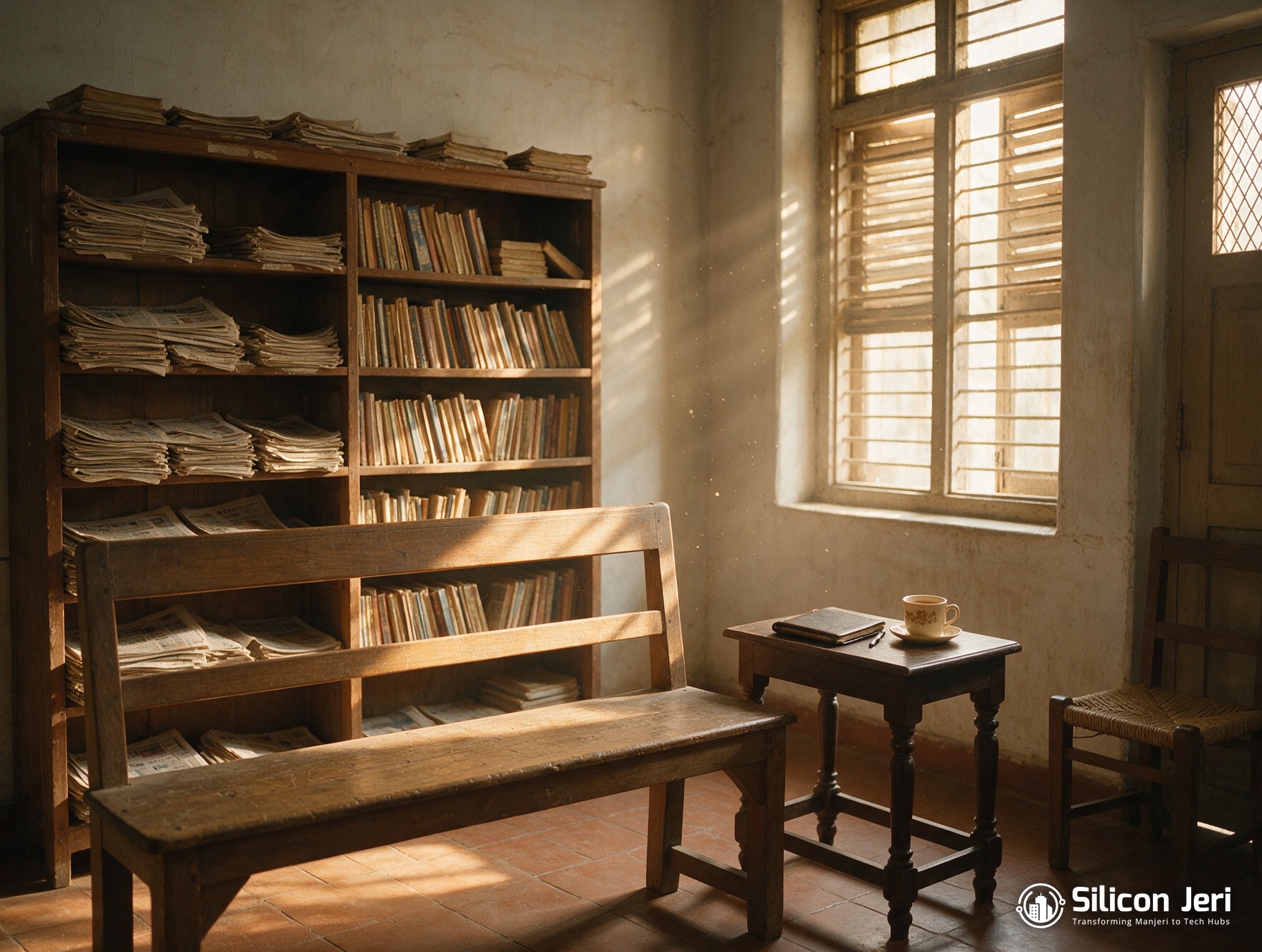
A vayanashala is a community reading room, usually a single room stocked with newspapers, a shelf or two of books, and sometimes a few magazines. Most are run by volunteers or a local reading room committee, and many are tied to Kerala’s public library network rather than operating as private clubs.
That network has real institutional weight. Panicker’s original 47-library association became the Kerala Grandhasala Sangham after statehood in 1956, and historians credit the movement it built with helping push Kerala toward near-universal literacy by the 1990s. That history is documented in detail in the record of P.N. Panicker’s work, the man Kerala credits as the founder of the movement.
Manjeri, like most towns in Malappuram district, has several vayanashalas, each tied to its own ward rather than to the town as a whole. That ward-level structure means a reading room’s fortunes depend on who lives and works nearby, not on citywide population trends. That local structure is exactly why a new cluster of workers at a coworking campus is worth examining, even without hard data yet.
The pressure on traditional reading rooms predates any tech campus
The decline in traditional reading room use across Kerala has been underway for years. Television arrived first, then smartphones, then a broader pattern of young people leaving small towns for college and work elsewhere. None of that is unique to Manjeri, and none of it is caused by Silicon Jeri. A coworking campus that gives some young people a reason to stay in or return to a small town would, if anything, work against that outflow rather than accelerate it.
| What has historically pulled members away | What could plausibly draw new visitors in |
|---|---|
| News and entertainment now arrive through phones and television, not the newspaper rack. | A need for a quiet place to focus, away from a shared desk or a noisy home. |
| Younger relatives who once brought elders to the reading room have moved away for work. | Curiosity about a local institution, especially among people new to Manjeri. |
| Fewer volunteers willing to take on the committee work a small reading room needs. | Free WiFi and a physical space, both useful to anyone carrying a laptop. |
None of this adds up to a rescue plan for reading rooms, and it should not be read as one. It is two long-running, well-documented trends that happen to be running through the same small town at the same time.
A hypothetical: what a shared-neighborhood reading room might look like today
To make the pattern concrete, imagine a typical ward-level vayanashala near a main road, the kind of small reading room found in dozens of Kerala towns. Before smartphones, it likely drew retirees in the afternoon and schoolchildren doing homework in the evening. A plausible, hypothetical version of that same room today might see a handful of newer faces on weekday evenings, people using the space quietly with their own laptop or phone rather than the newspaper rack.
This is an illustration of a pattern that could occur, not a report on any specific Manjeri reading room. No membership count or committee statement backs a claim that this is happening at any named vayanashala in the town.
Some Kerala libraries are proving the decline is not universal
The wider Kerala library system offers a useful counterpoint to a simple decline story. The EMS Cooperative Library in Kakkanad, near Kochi, reported roughly 15,000 members and over 90,000 books, and said it added around 800 new student members in a single year, according to reporting by Onmanorama. The same reporting described a defunct bus waiting shed near Vaduthala that residents turned into a working library, growing from 100 to 600 titles in eight months.
That does not prove anything specific about Manjeri. It does show that reading room decline is not automatic or universal across Kerala, and that community effort, not proximity to a tech campus, has been the main driver behind the libraries that are growing.
What digital adaptation actually looks like at this scale
Some Kerala libraries have added digital catalogues, audio formats for visually impaired members, and online-friendly services. Those are documented, real upgrades at libraries with enough volunteers and funding to manage them. A small ward-level vayanashala in Manjeri, run by a handful of volunteers on a thin budget, is a different kind of institution than a large cooperative library near a city.
For a small reading room, digitizing likely means something more modest: a WhatsApp group for members, a social media page to announce events, or a WiFi connection that makes the room useful to anyone who walks in with a device. There is no published evidence of a coordinated digitization effort tied to Silicon Jeri specifically. What is plausible, based on how small Kerala institutions generally adapt, is a scattering of individual, low-cost experiments rather than one organized push.
What this actually means for Manjeri
Two real, well-documented facts sit side by side in this town. Kerala’s reading room movement is a century-old, government-linked institution built for a different daily rhythm than a coworking crowd lives now. And that same movement, across the state, is neither uniformly dying nor uniformly thriving. It depends on volunteers, funding, and how well a specific room adapts to whoever lives nearby.
Whether Manjeri’s vayanashalas gain, lose, or simply coexist with the newer crowd at Silicon Jeri is not something this article can settle. It is a genuine open question, and any claim that it has already been answered, in either direction, should be treated with caution until a reading room committee or the state library system publishes real numbers.
Related reading: for a look at how the town’s institutions are adjusting on the policy side, see how Manjeri’s local government is adapting to the tech campus, and for a look at how civic organizations are approaching the same shift, see how community and faith institutions in small towns often adapt as tech hubs grow. For the documented history behind Kerala’s reading room network, see the record of P.N. Panicker’s library movement.
Frequently Asked Questions
What is a vayanashala?
A vayanashala is a community reading room, a small, often volunteer-run space in Kerala that offers newspapers, magazines, and a modest book collection to local residents. Many are tied to a ward-level committee and a state library council network rather than run as private businesses.
Is Silicon Jeri causing Manjeri’s reading rooms to shut down?
No. The decline in traditional reading room visits started long before Silicon Jeri existed, driven mainly by television, smartphones, and young people moving away for work. There is no published data linking Silicon Jeri to any reading room closing in Manjeri.
Are young tech workers actually joining reading rooms as members?
There is no published membership data on this for Manjeri specifically. Based on general patterns at small Kerala reading rooms, casual use of a space for WiFi or quiet is far more common than formal membership, book borrowing, or joining a committee. Treat any specific claim as a hypothesis, not a confirmed trend.
Why are Kerala’s reading rooms losing their traditional visitors?
The decline predates Silicon Jeri by years. Smartphones and television replaced the reading room’s newspaper racks as the main source of news for many households, and younger family members who once brought elders along have moved away for work or study, leaving fewer regular visitors.
Are all of Kerala’s reading rooms declining?
No. Some Kerala libraries have added members and expanded their collections in recent years, including one cooperative library near Kochi that reported around 800 new student members in a single year. Decline is common but not universal, and it depends heavily on local volunteers and funding.
What would meaningful adaptation look like for a small reading room?
For a small, volunteer-run vayanashala, realistic steps look like a WhatsApp group for members, a social media page, or a WiFi connection, not a full digital library. Larger, better-funded Kerala libraries have added digital catalogues and audio formats, but that scale of change is unlikely for a single-room ward reading room.