

 ChatGPT
 Claude
 Grok
Grok
 Perplexity
 Gemini
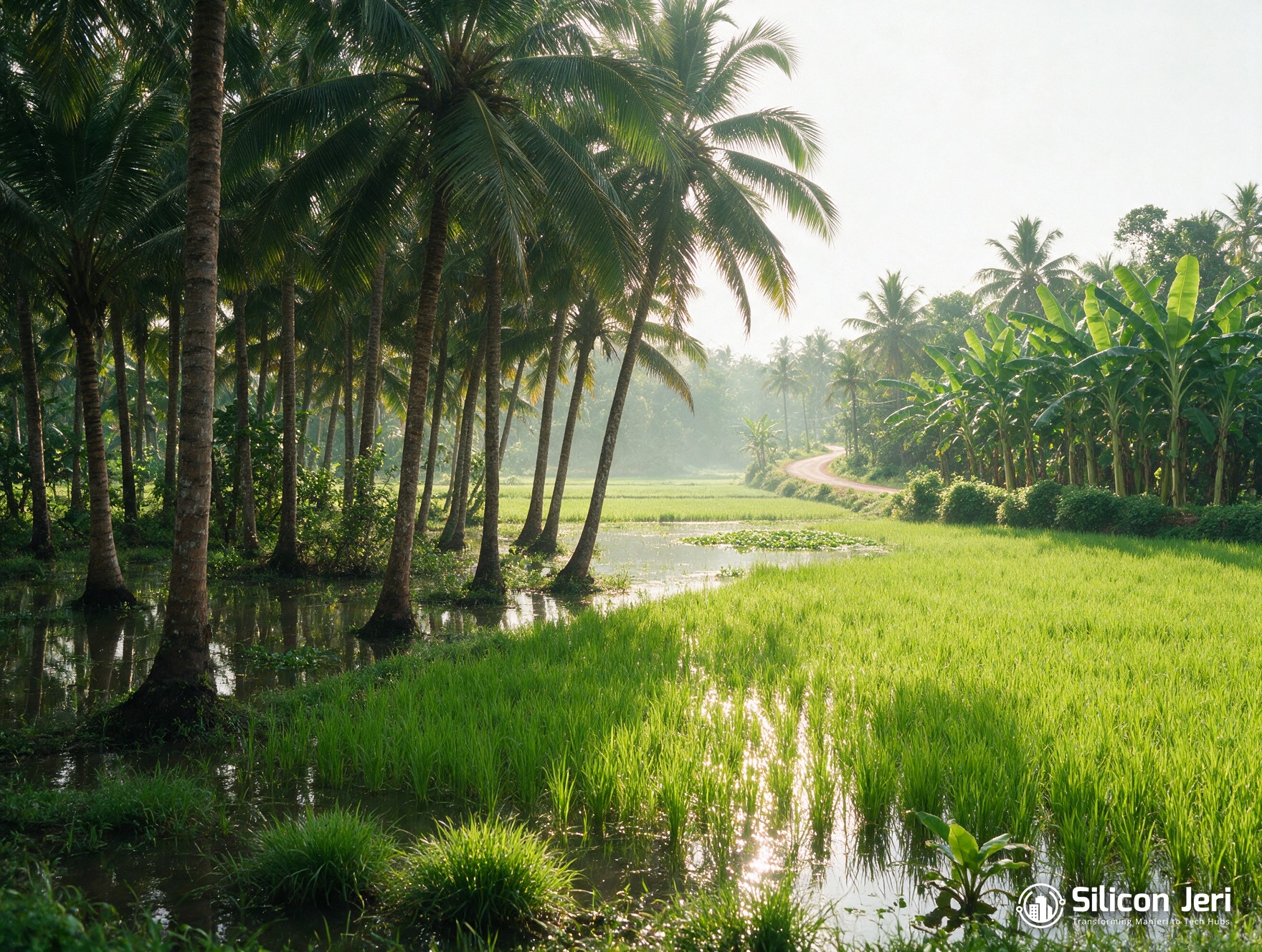
Drive a few minutes out of Manjeri and the view changes. Coconut palms, paddy fields, banana plants, and rubber trees take over from the shopfronts. So here is a fair question: could founders building startups in town make something for the farmers next door?
That is the idea behind agritech in Manjeri and Malappuram. It is a hopeful idea, not a proven trend. This article looks at it honestly, including the parts that make it hard. It does not claim that any agri-tech startup is working at the Silicon Jeri campus today.
- Malappuram has a mix of coconut, paddy, banana, rubber, and small mixed farms. That gives founders real problems to study close to home.
- Useful starting points include market prices, crop advice, direct selling, and moving produce from farm to buyer.
- Farm tech is hard because of trust, thin margins, small plots, and language.
- No agri-tech company at the campus is being claimed here. This is an open question, not a result.
- A sensible first step is listening to farmers, not building an app.
Why would a coworking campus care about farms at all?
Because Silicon Jeri is trying to prove something bigger than one building. The story is that a small Kerala town can grow a real tech scene, without every founder moving to a big city first.
A tech scene needs customers. Some founders will sell to companies far away. Others will look for problems on their own doorstep.
Malappuram’s farms are a very visible doorstep problem. They are everywhere, and they touch many families. Whether founders will actually build for them is not yet clear.
Here is the twist. The reason this idea is exciting is also the reason it is risky. Let us look at the ground first.
What does farming around Manjeri actually look like?
It is varied, and that matters. Many farms in Malappuram district are small and grow more than one crop. A single family may have a few coconut palms, a patch of banana, and some paddy in the right season.
- Coconut: A familiar sight across the district. Prices can move, and farmers often watch them closely.
- Paddy: Grown in low fields that depend on seasons and water. Timing matters a great deal.
- Banana: Sold fresh, so delays in reaching a buyer can hurt.
- Rubber: A longer-term crop, tied to prices that farmers do not control.
- Small mixed farms: A bit of everything, often run by families alongside other work.
Each crop has its own rhythm and its own headaches. A tool that helps a banana grower may mean little to a paddy farmer. That is the first lesson for any founder: there is no single “farmer” to build for.
It also connects to a bigger local story about how land use in this area has shifted over time. The links at the end of this article point to more on that. Now for the more practical question.
What could founders actually build for farmers?
Four ideas come up again and again when people talk about farmers and technology in Kerala. Each one starts with a real, everyday problem. None of them is a sure thing.
| Idea | Problem it tries to solve | What makes it hard |
|---|---|---|
| Market price updates | Farmers often do not know what a crop is fetching elsewhere on a given day. | Prices change often, and the data has to be trusted. |
| Crop advice | Questions about pests, weather, and timing need quick, clear answers. | Bad advice can cost a whole season. |
| Direct selling | Farmers may want to reach buyers without several middle steps. | Buyers want steady supply, which small farms find difficult. |
| Supply chain help | Fresh produce loses value when pickup and transport are slow. | It needs real people, vehicles, and timing, not just a screen. |
Notice something about that last column. Almost every hard part is about people and trust, not code. That is the point most tech pitches skip.
Why is farm tech so hard to get right?
There are four big reasons, and they show up in farm tech almost everywhere. They are not unique to Kerala.
- Trust comes first. A farmer who has worked the same land for years will not change habits because a stranger’s tool says so. Trust is earned slowly, often through people the farmer already knows.
- Margins are thin. Many farms earn little after costs. A new tool has to save or earn money quickly, or it will not be used. Even a small monthly cost can feel heavy.
- Plots are small. Some farm tech works well mainly on large, flat, uniform land. Malappuram’s many small plots do not fit that picture neatly.
- Language and comfort matter. A tool that only works well in English, or that needs a lot of typing, will lose many users. Malayalam, simple voice or picture options, and patient help all matter.
Here is the part that surprises many founders. The tech itself is rarely the hardest piece. Reaching farmers, earning their confidence, and staying useful through a bad season is the real work.
Is there any proof this can work in Manjeri?
No, not yet. This is the honest answer, and it should be said plainly.
There is a general field called precision agriculture, which uses data to help farmers make better choices on their land. It shows that farm tech is a serious idea elsewhere. It does not show that it will work in Malappuram, with its small mixed farms and local habits.
Here is what can be said fairly today.
- Real: A coworking campus exists in Manjeri, and founders are working there on their own ideas.
- Real: Farms are a large part of the surrounding landscape and many families depend on them.
- Not shown: That any founder at the campus is building for farmers, or that farmers would use it if they did.
So this is a possibility, not a pipeline. It is a bit like health tech, another local-market test where the town itself is the customer.
What would a sensible first step look like?
Start small, and start by listening. Picture a founder named Meera. She is an illustrative example, not a real person.
Meera does not build anything yet. She spends a few weeks talking with farmers, small traders, and family members who help with the harvest. She asks simple questions. What do you wish you knew earlier? Who do you trust for advice? What went wrong last season?
Then she picks one narrow problem, such as knowing when and where to sell bananas. She tests a very simple answer, maybe just a message, before she builds anything complex. If farmers ignore it, she learns something. If they ask for more, she has a real signal.
That approach is slower than launching an app. But it fits how trust works in a farming community.
A few habits would help any founder trying this.
- Work with farmers, not around them. Ask for feedback early and often.
- Pick one crop and one problem. Broad tools tend to help no one.
- Design for low effort. Simple screens, Malayalam, and short steps.
- Be honest about limits. If a tool cannot help with a problem, say so.
A useful next step for anyone curious about building at the campus is to call +91 97783 49944 and ask what is happening there now. There is no promise that farm tech is on the list.
Related reading: To understand the land itself, see what happened to Manjeri’s farmland. For another test of building for the local market, read how health tech could be another local-market test. For general background on data-driven farming, see Wikipedia’s page on precision agriculture.
Frequently Asked Questions
Is there an agri-tech startup at Silicon Jeri today?
None is being claimed here. Silicon Jeri is a coworking campus in Manjeri, and founders there work on many ideas. Whether any of them will build for farmers is still an open question. This article treats agritech in Malappuram as a hopeful possibility, not an existing result.
What crops are grown around Manjeri and Malappuram?
Malappuram district has coconut, paddy, banana, and rubber, along with many small mixed farms. Many families grow more than one crop on a small piece of land. This variety matters for founders, because a tool that suits one crop may not help farmers who grow something else.
Why is farmers technology in Kerala hard to build?
Four things make it hard. Farmers need to trust a tool before using it. Margins on many farms are thin. Plots are often small. Language and ease of use also matter, since a tool that needs a lot of typing or English will lose many users. Reaching people is usually harder than the technology.
What could a farm tech founder in Manjeri build first?
A sensible start is one narrow problem for one crop, such as knowing where to sell at a fair price. Talk with farmers first, then test a very simple answer before building anything complex. Ideas often discussed include market price updates, crop advice, direct selling, and help moving produce to buyers.
Is agri-tech in Malappuram a proven trend?
No. It is a hopeful idea that has not been shown to work locally yet. Precision agriculture is a known field elsewhere, but it has not been proven for small mixed farms in Malappuram. Any real progress would need farmer trust, steady use, and results that last through more than one season.