

 ChatGPT
 Claude
 Grok
Grok
 Perplexity
 Gemini
A software engineer who just moved to Manjeri for a job at a startup based at Silicon Jeri has one urgent problem that has nothing to do with code. Where does the next meal come from.
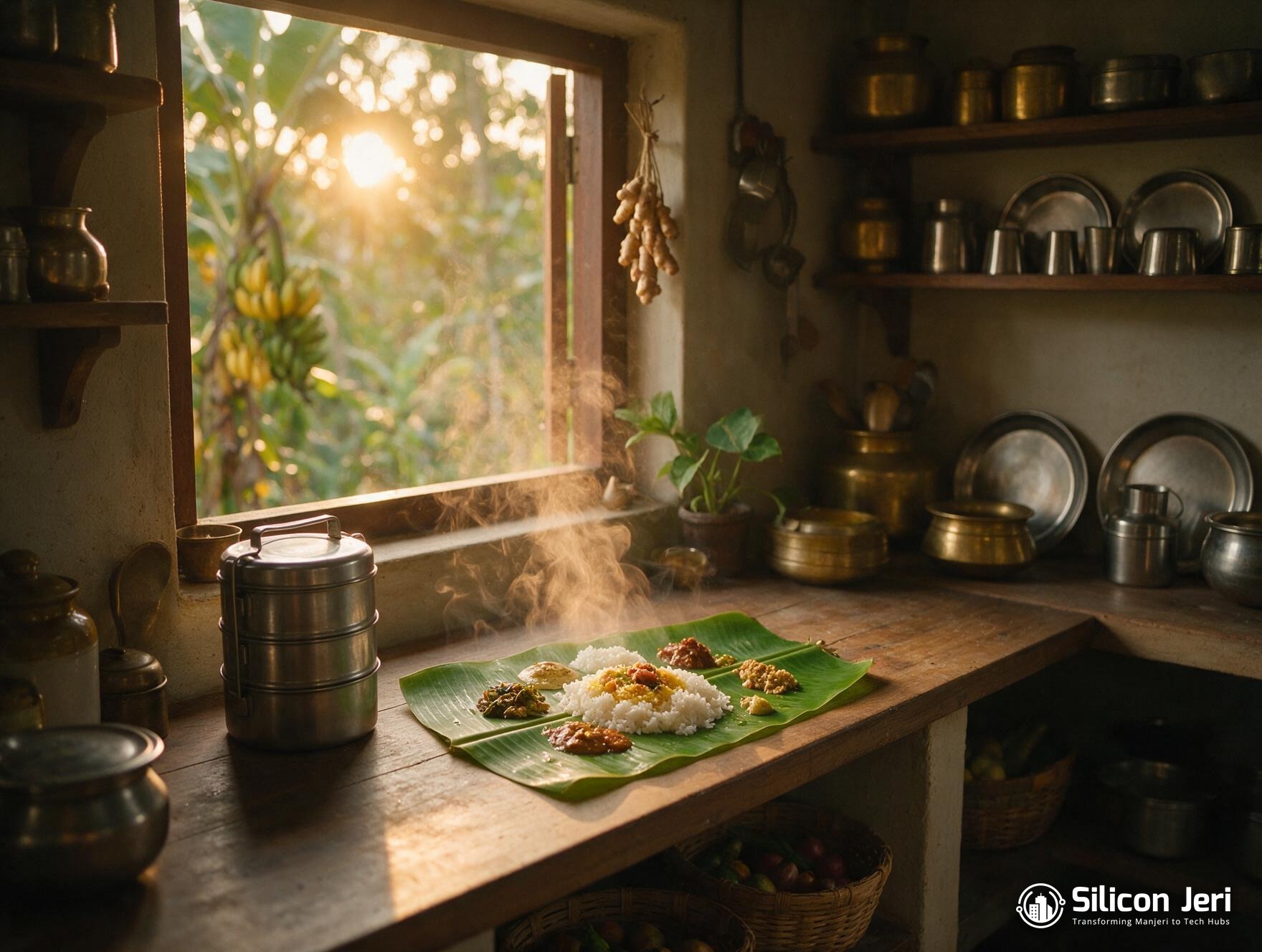
Six months ago, that question sent most new arrivals to the same two or three hotels near the campus. Today, a growing number of them get a steel tiffin box delivered to their desk instead, packed that morning in a home kitchen a few streets away.
This shift is small. It will not show up in any funding announcement. But it is one of the clearest signs that Manjeri’s food economy is adjusting to a new kind of resident, the relocated tech worker who wants a home-cooked meal and does not have a home nearby to cook it in.
- Tiffin services and small home kitchens are filling a gap that cafes and hotels near Silicon Jeri do not cover well: a daily, home-style lunch or dinner for people who live alone.
- This demand exists because startups operating out of the campus bring in employees from outside Malappuram who do not have family kitchens in Manjeri.
- Several home cooks appear to be scaling into small cloud kitchen setups, cooking to order for delivery instead of running a walk-in shop.
- This is an early-stage, informal trend. There is no verified count of how many tiffin operators or cloud kitchens now serve the tech crowd.
- The pattern fits a wider story: as Manjeri becomes known as Silicon Jeri, ordinary local businesses, not just offices, are adapting to a new customer base.
Why did Manjeri need new food options once tech workers started arriving?
Manjeri already had food. Hotels, bakeries, and small restaurants have served the town for years. What it did not have, in the same way, was a steady supply of relocated single people who eat lunch and dinner alone on weekdays.
Most people in Manjeri eat at home, cooked by family. A techie who has taken a role at a company based at the campus and moved from another district does not have that setup. Hostel or rented-room living means no kitchen, or a kitchen with no time to use it after a long workday.
Hotel food works for one meal. It gets expensive and repetitive for two meals a day, every day, for months. That gap is exactly where tiffin services and home kitchens have stepped in.
Here is the part most people miss. This is not a story about restaurants competing with each other. It is a story about a whole category of eating, the daily home meal, that did not exist as a purchasable service in Manjeri before the tech crowd showed up in numbers.
What exactly is a tiffin service, and how is it different from ordering from a hotel?
A tiffin service is a simple idea. A home cook or a small kitchen prepares a fixed meal, usually rice, a vegetable dish or two, dal or sambar, and sometimes a curd or pickle, and packs it into a steel or plastic tiffin carrier. The carrier gets delivered on a schedule, often daily or for a set number of days a week.
It is built around three things that ordering from a hotel menu does not always offer:
- A fixed, home-style menu instead of an a la carte restaurant menu.
- A regular delivery time, so the customer does not have to remember to order every day.
- A meal built closer to what someone would cook at home, not what a hotel serves to walk-in customers.
For someone new to Manjeri, this matters more than it sounds. A predictable, familiar meal removes one more thing to think about in an already unfamiliar town.
How are home kitchens turning into small cloud kitchens near Silicon Jeri?
A cloud kitchen is a kitchen that cooks only for delivery or pickup, with no dining space for walk-in customers. Several home cooks in and around Manjeri appear to be moving in this direction, scaling up from cooking for a handful of known families to taking orders from strangers over WhatsApp or a phone call.
Consider an illustrative example. Picture a home cook we will call Latha chechi, a composite example and not a real named business, who has cooked for her own family and a few neighbors for years. As more techies moved into rented rooms near her street, she started taking two or three extra tiffin orders a week. Over time, those orders became a small daily routine, cooking a slightly larger batch, packing it into carriers, and coordinating pickup or delivery around the time nearby offices break for lunch.
This pattern, small and informal at first, then gradually more structured, is what people mean when they say a home kitchen is becoming a cloud kitchen. There is no storefront. There is no dining table for customers. There is just a kitchen, a phone, and a delivery route that grows with word of mouth.
Now the part that surprises people. This shift does not need new investment in a building or new equipment in most cases. It mostly needs a few more regular customers and a reliable way to take orders and get food delivered on time.
What does a typical food option look like for someone working at a company based at Silicon Jeri?
People who have relocated for a role connected to the Manjeri tech ecosystem generally choose between a few options, each with its own trade-off. The table below lays out the general pattern, based on the kind of choices new arrivals in a similar situation tend to describe, not on any verified survey data.
| Option | What it offers | Common trade-off |
|---|---|---|
| Hotel or restaurant meals | Wide menu, easy to find, no advance order needed | Can feel repetitive and less home-style over time |
| Tiffin service | Home-style fixed menu, regular schedule | Less menu choice on any given day |
| Small cloud kitchen | Order-to-order cooking, sometimes more variety than a tiffin plan | Availability depends on how many orders the cook can handle that day |
| Cooking at home | Full control over what and when to eat | Needs time, a working kitchen, and energy after a full workday |
Most people do not pick just one. A common pattern is a tiffin plan for weekdays and hotel food or home cooking on weekends, when there is more time to plan.
What challenges do these home cooks and small kitchens actually face?
Running a tiffin service or a small cloud kitchen out of a home is not simple, even at a small scale. A few challenges come up again and again in this kind of setup.
- Cooking to a schedule every single day, including days the cook is unwell or has a family event, with no backup staff.
- Managing orders and payments informally, often over phone calls or messaging apps, without dedicated software.
- Keeping food fresh and hot through delivery, especially when the customer is some distance from the kitchen.
- Scaling up demand without scaling up kitchen space, since most of these setups still work out of a regular home kitchen, not a managed commercial one.
- Balancing new orders from techies with existing regular customers, who may have been buying from the same cook for years.
None of this is unique to Manjeri. It is the same set of problems small food businesses face anywhere demand grows faster than the setup behind it. What is notable here is simply that this demand exists at all, and that it traces directly back to the arrival of tech workers.
Why does this matter for Manjeri’s transformation into Silicon Jeri?
A tech hub is usually described through its offices, its startups, and its funding numbers. The food side rarely gets mentioned, but it may be one of the more honest signs that a transformation is real.
When a town’s economy shifts because of a new industry, the change does not stop at the industry itself. It moves outward, into housing, transport, retail, and food, because the people who work in that industry still need to eat, live, and move around like everyone else.
Tiffin services and home kitchens picking up new customers is a small, local version of that ripple effect. It does not require a big investment. It does not need a press release. It just needs one home cook noticing that a new kind of customer, someone without a family kitchen nearby, has moved into the neighborhood, and deciding to pack one more tiffin box tomorrow.
That is arguably the clearest, least polished evidence that Manjeri’s identity is changing. Not the campus itself, but the kitchen down the street that now cooks for people it did not know a year ago.
Related reading: tiffin services are one piece of a bigger everyday-needs shift in town, alongside the cafes, gyms, and clinics opening in Manjeri to serve Silicon Jeri’s workforce. Housing and food tend to move together too, as covered in the co-living and PG startups springing up to house Silicon Jeri’s newcomers. The idea of a home-cooked meal delivered daily is close to what most people picture when they hear the word tiffin.
Frequently Asked Questions
What is a tiffin service in Manjeri?
A tiffin service is a home cook or small kitchen that prepares a fixed, home-style meal and delivers it on a regular schedule, often daily, using a steel or plastic tiffin carrier.
Why has demand for tiffin service in Manjeri grown near Silicon Jeri?
Startups operating out of the campus bring in employees from outside Malappuram. Many of these workers live alone in rented rooms without a family kitchen, so they look for a regular home-style meal option instead of eating at a hotel every day.
What is the difference between a tiffin service and a cloud kitchen?
A tiffin service usually follows a fixed menu delivered on a set schedule. A cloud kitchen cooks to order for delivery, often with more day to day variety, but it has no dining space for walk-in customers.
Are there named cloud kitchen brands serving Silicon Jeri right now?
This article does not name specific businesses. The examples described are illustrative and meant to show a general pattern, not to promote or verify any particular operator.
How is this trend connected to Manjeri becoming known as Silicon Jeri?
As tech workers relocate for roles connected to the Manjeri tech ecosystem, local businesses outside the tech sector, including home kitchens and tiffin services, adjust to serve this new customer base. That ripple effect is one sign of a real economic shift, not just a change in office space.
What challenges do small tiffin and cloud kitchen operators face in Manjeri?
Common challenges include cooking to a strict daily schedule without backup staff, managing orders informally over calls or messaging apps, keeping food fresh through delivery, and scaling demand without a larger, managed kitchen setup.